
Why Your South Florida Home’s Windows Are Its Weakest Point in a Hurricane
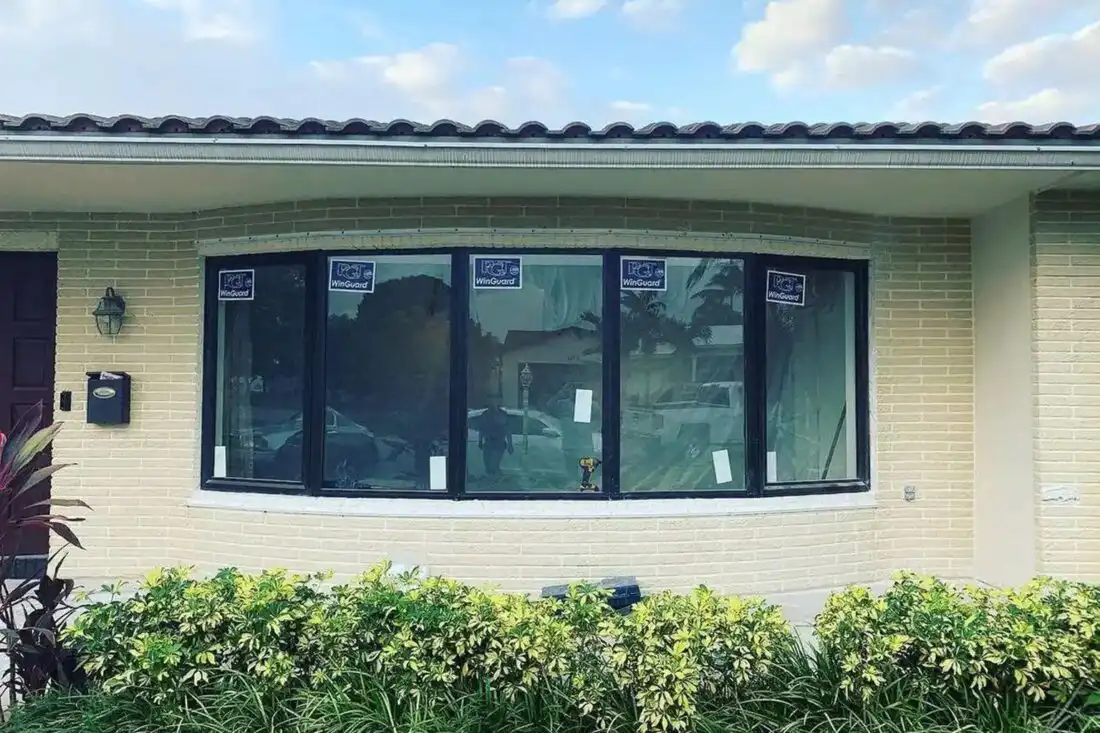
Storm worries in Broward and Miami-Dade usually get ranked the same way: the roof first, then the trees, then the water. The roof is the expensive part, so it takes most of the budget.
Houses in high wind tend to fail at their openings rather than their walls, and an opening is usually the cheapest part of the envelope. A window gives way, or a door does, and most of what follows is a consequence of that one hole. The reason windows are the weakest point in a hurricane has more to do with air pressure than with glass.
Once that mechanism is clear, the rest of the decisions get easier, including why the Florida Building Code treats openings as protection rather than finish work.
A House Resists Wind as a Sealed Box
Wind moving around a house creates positive pressure on the wall facing the storm and suction on the roof and the walls facing away from it. While the envelope stays closed, the inside holds a fairly steady pressure and the structure only resists loads on its outside surfaces. That is what every strap, anchor and roof connection was sized for.
Break one window and the house stops being a sealed box. Air pushes in through the opening and pressurizes the interior, so the underside of the roof deck is pushed up at the same moment the outside of it is pulled up by suction. The walls get it from both directions at once, and the two loads add rather than cancel. That combination is the usual explanation for a roof coming off a house whose walls still stand.
Wind design accounts for this directly. ASCE 7, the standard the Florida Building Code uses for wind loads, treats a building with a dominant hole in one wall as a different class of structure, designed for a higher internal pressure than a sealed one. A broken bedroom window is enough to change which class the house is in. Nothing about the roof changed; the load on it did.
Why Windows Are the Weakest Point in a Hurricane
Glass resists steady pressure well and point impact poorly: a window that would hold all day under the design pressure for its wall can still be taken out by something small moving at moderate speed. The National Hurricane Center describes the hazard as a list of ordinary objects: signs, roofing material, siding and small items left outside, all of which become flying missiles in a storm.
Florida’s test protocols are built around that idea rather than around wind speed. For the large missile test used in the High Velocity Hurricane Zone, the code specifies a nine-pound piece of nominal two by four timber, fired at the sample at fifty feet per second, or about 34 miles per hour. Each sample takes two hits, one near the middle and one in a corner six inches from any supporting member. Survivors then face a pressure cycling test, because cracked glass still has to hold the pressure difference for the rest of the storm.
That sequence is what impact glazing is for. The laminated interlayer is not there to stop the glass cracking; it is there to keep the cracked glass in the frame, so the opening stays closed and the house stays at the pressure the structure was designed around.
What the Florida Building Code Requires in Broward and Miami-Dade
Broward and Miami-Dade are not held to the statewide wind-borne debris rules. Section 1601.1 sends work inside the High Velocity Hurricane Zone to Sections 1616 through 1626 instead, and Section 1626 is the one that reaches your openings. It covers all parts or systems of the building envelope, naming exterior walls, roof, outside doors, skylights, glazing and glass block, so the requirement is not limited to windows. Height changes the test as well, with openings up to thirty feet above grade facing the large missile and anything higher the small one, so two openings on the same house can carry different ratings.
The code is not asking for better glass for its own sake. It is asking you to keep the envelope closed, and it accepts either route: hurricane impact windows rated on their own, or an approved covering over ordinary glazing. The difference is whether the protection is already there when a storm is three days out.
The Openings That Tend to Give First
Openings do not carry equal risk. A sliding glass door is usually the largest single hole in a South Florida house, with the most glass area, the longest unsupported frame span and a short path to the patio furniture that becomes debris. It is also the one homeowners are least likely to have protected, since panels and shutters are awkward across a wide run.
Entry doors fail differently. The pressure works on the latch and hinge side, and on older units the weak link is usually the hardware and the anchoring into the jamb, not the slab. A door that carries no impact rating behaves like an opening rather than a wall.
Garage doors belong on the list too, though they are not something we sell or install. A double garage door is a wide, lightly framed panel that wind can push inward until it leaves its track. The garage fills, and the same mechanism applies to the whole house. IBHS describes that sequence, and the code’s own list of referenced impact standards includes ANSI/DASMA 115 for garage and rolling doors. If yours carries no rating, it belongs beside your windows.
A Rated Window Is Only Rated as Installed
Approval in Florida attaches to an assembly, not to a pane of glass. Products used in Broward and Miami-Dade carry either a Miami-Dade County Notice of Acceptance or a Florida Product Approval that covers the HVHZ, and that document describes the unit as tested: the glazing, the frame, the anchor type, the fastener spacing and the material it was anchored into. Install the same unit with different fasteners, or into a buck detail the approval never covered, and it is no longer the product that passed.
So installation matters more than the brochure. Anchors have to reach sound structure, the buck has to suit the wall, the perimeter has to be sealed, and the permit drawings have to match the approval in use. The same goes for an impact-resistant entry door, where the approval covers the slab, the frame and the hardware as one unit. Inspectors in both counties look at exactly those details.
We are an authorized PGT dealer, including the former CGI lines, and a certified general and glazing contractor. We also carry ECO Window Systems, ES Windows and ESR Impact System.
Where to Start on Your Own Home
If you are deciding where the money goes first, list every opening in the envelope, not every window. Count the sliders, the entry doors, the garage door and any skylight, then note which ones already carry a rating or a code-approved covering. The unprotected opening with the most glass area usually sets your risk.
If you want a second set of eyes on that list, we can walk the house, check what each opening is rated for and tell you what a permit in your city requires. Contact us or call 954-989-7722 to set that up.